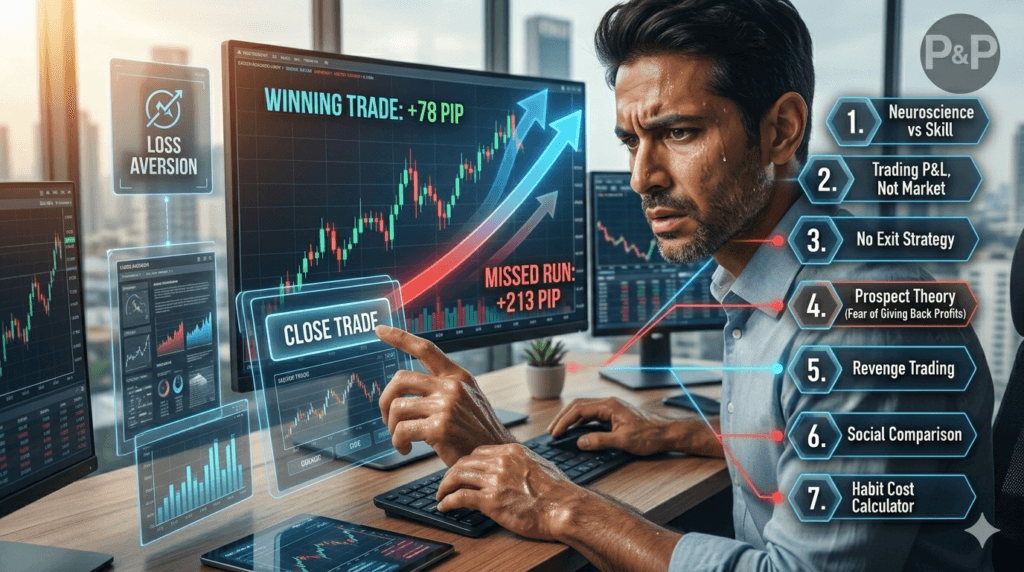
Psychology of Trading is the invisible force that determines whether you end the day in green or deep red. I’ve been in the trenches—developing bots at SS Tech and managing automation for complex strategies—and I can tell you one thing: even the most perfect code can’t fix a broken mindset. In 2026, the markets move faster, the AI is smarter, and if you aren’t fixing your mental game, you are just providing liquidity for those who are.
At Pips and Pixels, I always emphasize that “Pips” are won in the mind before they are won on the chart. If you find yourself hitting the “Buy” button out of boredom or revenge-trading after a loss, you aren’t alone. But to grow, you must evolve.
Here are 7 powerful fixes based on the Psychology of Trading that will stop your cycle of mistakes.
1. Stop Chasing the “Ghost” of Past Losses
The biggest hurdle in the Psychology of Trading is the inability to let go. We’ve all been there: you lose a trade on $NVDA or $INTC, and suddenly, you feel the market “owes” you. This is called the ‘Recency Bias.’ In 2026, where volatility is high, chasing losses is like running into a burning building to save a penny.
- Fix: Treat every trade as an isolated event. Your last loss has zero mathematical connection to your next setup.
2. Overcoming the Fear of Missing Out (FOMO)
With Solana pump-fun bots and rapid crypto cycles, FOMO is at an all-time high. The Psychology of Trading tells us that the fear of not being “in” on a move often leads to buying at the absolute top. This emotional trigger is exactly why many professionals are moving towards automation.
- Fix: Build a “Waitlist” rule. If you can’t control your FOMO manually, it’s time to learn how to Stop Emotional Trading: Why AI Trading Bots for USA Stocks 2026 are Necessary to keep your logic intact.
3. The Danger of “Revenge Trading”
When a bot I develop at Nexify Studio fails a backtest, I don’t get angry at the code; I fix the logic. But when humans trade, we take it personally. Revenge trading is the fastest way to blow an account. It’s an emotional reaction to a logical problem.
- Fix: If you lose two trades in a row, close the laptop. Walk away. The market isn’t your enemy; your lack of discipline is.
4. Emotional Attachment to Your “Bias”
Many traders fall in love with a stock or a direction. They want Intel to win or Bitcoin to hit $200k so badly that they ignore the bearish signals. A core pillar of the Psychology of Trading is being objective.
- Fix: Play “Devil’s Advocate.” Every time you want to Buy, list three reasons why you should Sell. If you can’t be objective, don’t trade.
5. Underestimating the Stress of Over-Leveraging
High leverage is like a drug. It feels great when you’re winning, but the Psychology of Trading proves that too much risk causes “Analysis Paralysis.” When your position size is too big, you can’t think clearly. You exit too early or stay in too long because the dollar amount scares you.
- Fix: Never risk more than 1% of your equity on a single trade. If you can’t sleep while a trade is open, your size is too big.
6. The “Boredom” Trade Trap
In 2026, we are addicted to stimulation. If the market is sideways, traders feel they must do something. The Psychology of Trading teaches us that “Sitting on your hands” is actually a position.
- Fix: If the setup isn’t in your journal, don’t touch the keyboard. Use that time to improve your website, research new sourcing on Alibaba, or learn a new script.
7. Ignoring the “God Complex” After a Win Streak
The most dangerous time for a trader isn’t after a loss—it’s after a 10-trade win streak. You start feeling invincible. You ignore your rules. This is where the Psychology of Trading warns about “Overconfidence Bias.”
- Fix: Stay humble. The market doesn’t care about your streak. Stick to the same process that got you the wins in the first place.
Final Thoughts: The Mindset of a 2026 Trader
Whether you are building bots like me or trading manually on the PSX, your mind is your most valuable asset. The Psychology of Trading isn’t a “soft skill”—it’s a hard requirement. If you can master your emotions, you can master the markets.
At Pips and Pixels, we believe in the synergy of data and discipline. Don’t let your pixels be blurred by the emotions of your pips.
Important Resources for Traders:
- Check out Investopedia’s Guide on Trading Psychology (External).
- Read the latest on SEC Market Insights (External).
- Ready to remove human error from your strategy? See why you should Stop Emotional Trading: Why AI Trading Bots for USA Stocks 2026 are Necessary.